How to... Ten top tips: preventing pressure ulcers
01/09/11 | Pressure ulcers, Service development and delivery, Wellbeing and concordance | Marie Wilson
Pressure ulcers are defined as localised damage to the skin and/or underlying tissues usually caused by sustained pressure at the interface between bone and soft tissue. Pressure ulceration can range in severity from non-blanching erythema of intact skin (tissue redness that does not turn white when pressure is applied with a finger), to deep tissue loss with muscle, tendon, and/or bone involvement[1]. They are caused by both extrinsic and intrinsic factors[2]. The intrinsic factors include immobility, sensory impairment, age and/or chronic illness[3,4]. The extrinsic factors include forces such as shear, friction and pressure[1].
Tips for preventing pressure ulceration
1
Risk Assessment: risk assessment tools, such as the Waterlow and Braden scales[2,5], act as a prompt enabling clinicians to recognise any risk of pressure ulcer development. They encompass a range of factors known to influence the development of pressure ulcers, such as those mentioned above.
All patients should have a pressure ulcer risk assessment undertaken within six hours of admission into an acute area, and this should be regularly reviewed throughout their stay[4]. This will aid identification of individuals with an increased risk of pressure ulceration at the earliest stage.
It is vital that structured and clearly documented risk assessment is undertaken to ensure that risk factors
are recognised and acted upon in an appropriate and timely fashion.
2
Skin: a skin inspection should be undertaken to assess the skin's general condition and any existing damage. Dry, moist, undernourished and fragile/aged skin is generally more at risk of pressure damage than nourished, hydrated skin. The first indication of tissue/pressure damage is often non-blanching erythema, usually over a bony region. Other signs to look for are localised heat, induration (hardness) and oedema (swelling).
When assessing darkly pigmented skin, recognising erythema can be difficult. The National Institute for Health and Clinical Excellence (NICE) in the UK[4] suggests observing the skin for any discolouration or colour changes combined with the signs above. Feeling the local/surrounding skin, with the patient's prior permission, is often the best way to determine differences in tissue.
3
Skin care: it is important to consider the care of the skin and to remember that clinicians can inadvertently cause damage. Excessively vigorous rubbing of the skin when drying, for example, may cause pain as well as damaging the tissue, especially over a bony region. When assisting patients to dry themselves, clinicians should encourage them to pat the skin dry and use an emollient to rehydrate any dry skin. Clinicians should also consider if and when the individual actually requires a full wash. However, it is also crucial to ensure that any area contaminated by incontinence or wound exudate is well cleaned and dried as these contaminants can have detrimental effects on the skin.
4
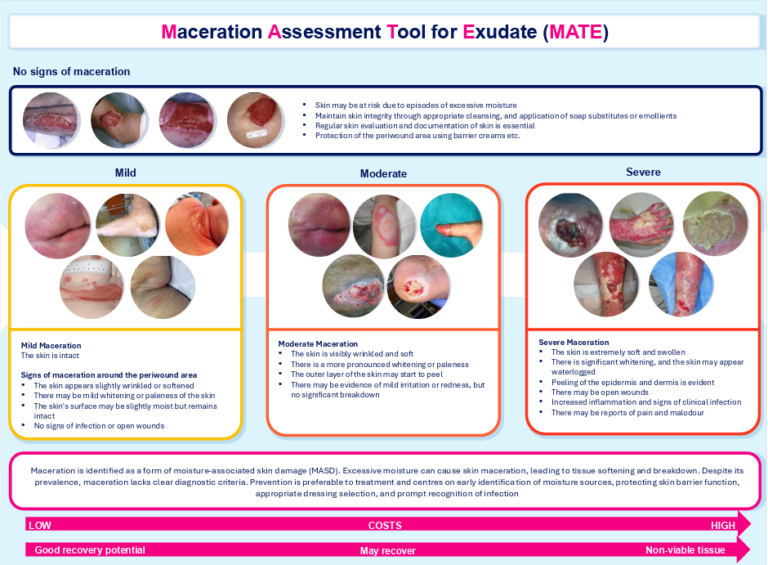
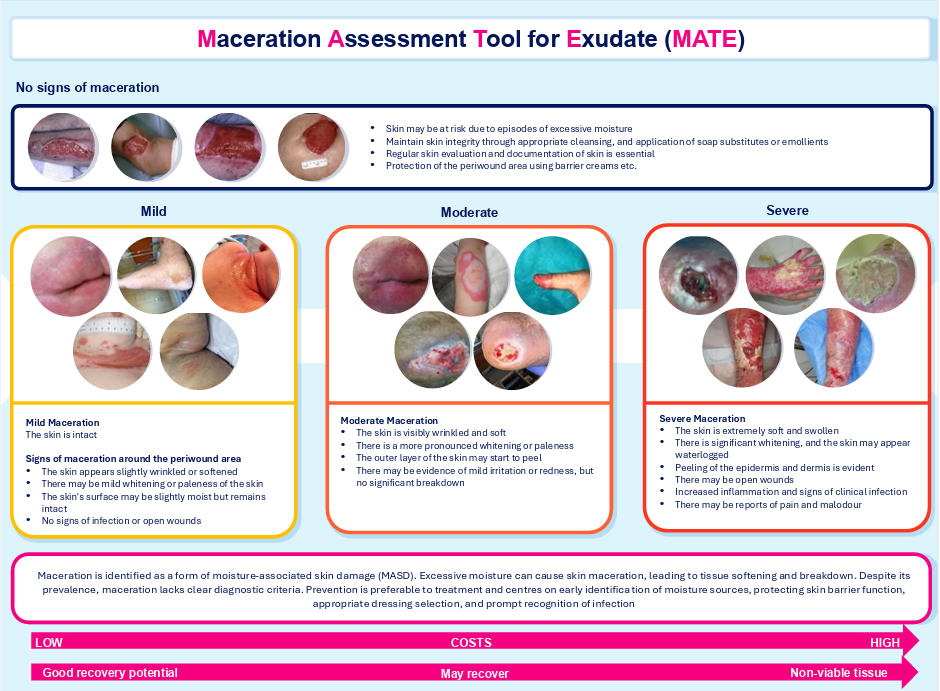
Moisture: factors such as high temperature, excessive perspiration, oedema and incontinence may all place the patient at risk of skin damage from excess moisture. Prolonged exposure to moisture can waterlog the skin, leaving it macerated. This softens the connective tissue and may lead to an increased risk of pressure ulcer development. These factors must be addressed individually, with the aim of reducing the risk of pressure ulcer development. In the author's experience, one of the main predisposing factors for pressure damage is incontinence.
5
Incontinence: incontinence and pressure ulcers are common and often co-exist. In urinary incontinence the urea contained in urine decomposes the skin, resulting in the formation of ammonium hydroxide, which in turn raises the pH balance of the skin encouraging bacterial proliferation[6]. In faecal incontinence, enzymes such as proteases and lipases degrade the barrier function of the skin, again allowing microorganisims to proliferate and enabling bacterial and fungal growth. The excoriation from both urinary and faecal incontinence can become unbearable for the individual.
The use of incontinence pads in conjunction with the appropriate application of a barrier cream will assist with this problem, while the use of indwelling urethral catheters should be considered as a last resort due to the risk of infection. It is important to remember that incontinence pads should be smoothed prior to application to reduce ridges and creases. Equally the pad with the most suitable absorbency and shape should be chosen on an individual basis. The use of multiple pads and pads that have been stretched over support surfaces are not recommended as they are likely to reduce the efficacy of any pressure redistribution.
6
Nutrition: good nutrition is essential for pressure ulcer prevention and healing. Patients should be screened and their nutritional status assessed. Under-nutrition is a reversible contributor to pressure ulcer development and as such early identification and management of poor nutrition is of vital importance[1]. Local nutritional/dietetic guidelines should be followed and if there is any doubt relating to the assessment of a patient's nutritional status, a referral should be made to the dietetic department. It is also always important to encourage liquid intake as hydration is as important as nutrition.
7
Position/mobility: the position in which patients are sitting/lying will effect how much pressure is exerted over their pressure areas. This is obviously dependant on patients' ability to reposition themselves and their recognition of the need to do so. For example, people with cognitive impairment may not have the capacity to understand the need to regularly reposition themselves and people who have just undergone surgery may be restricted in the amount of movement they can undertake.
8
Ergonomics: ergonomics is concerned with the ‘fit’ between people, their equipment and the immediate environment. It takes account of a person’s capabilities and limitations with the aim of ensuring that all aspects of his or her environment are suited to aiding in the performance of tasks. In the case of people with pressure ulcers, ergonomics may refer to activities of daily living and repositioning.
In pressure ulcer prevention it is important to consider ergonomics when choosing furniture such as beds, bed-side chairs and mattresses. For example, a bariatric patient might be placed in an ill-fitting bed with side rails, which could result in skin folds/excess skin becoming trapped or undergoing excess pressure from the equipment, increasing the risk of pressure ulcer development.
Equally, it is important to remember that not all bedside chairs 'fit all' and that the human body comes in many different forms. As much as is possible, clinicians should aim to position the person in a chair that is at the correct height, depth and width, while ensuring the weight is evenly distributed.
9
Repositionng: all patients should be encouraged to reposition themselves regularly when able to do so. For those who require assistance, repositioning should be undertaken with consideration for the patient's comfort, dignity and functional ability. Any repositioning must take into account that the while pressure is relieved/redistributed it is also important the patient is able to function, for example, take diet and fluids in that position.
When repositioning a patient, manual handling aids must be used to avoid dragging the individual along the mattress, which can cause tissue damage through shear and friction.
If the individual is to remain in bed, his or her position should be changed regularly and at least every two hours (although this should be adjusted to suit individual requirements as some patients may need more frequent intervention than others). Patients should be rested at a 30-degree tilt and on alternate sides to avoid prolonged pressure at bony prominences. Clinicians should always follow local protocols.
10
Pressure-redistributing equipment: pressure ulcer equipment has two main functions — to redistribute pressure and to provide comfort[7]. Most acute trusts in the UK have static (foam) mattresses with integral pressure-relieving properties. NICE[4] states that no patient at risk of pressure ulceration should be nursed on anything less than a high density foam mattress.
Active support surfaces should be used only after appropriate assessment of the individual. Clinicians should remember that on occasion patients may have their independence reduced by the use of these mattresses, for example patients who have experienced a cerebrovascular accident and have decreased spatial ability may find it difficult to reposition themselves on an alternating system.

Seating must also be considered as patients are at greater risk when seated than they are when lying in bed due to their weight resting on a smaller surface area. It is generally considered that patients at risk of pressure damage should also have a pressure-reducing cushion on their seating.
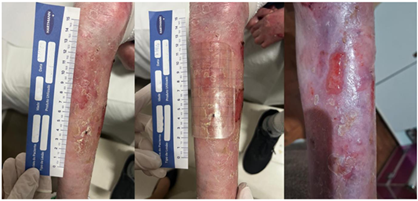
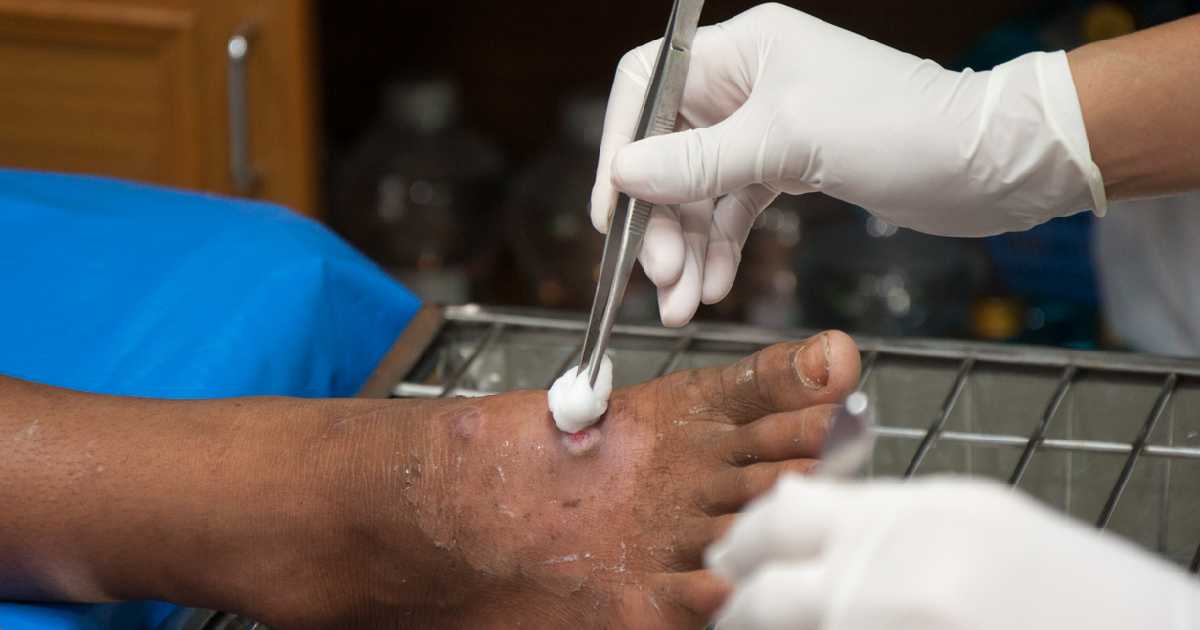
Figure 1 (at top): A pressure ulcer located on a patient's heel.
AUTHOR DETAILS
Marie Wilson, is Tissue Viability Clinical Nurse Specialist at Croydon University Hospital, UK.